
 Emerging evidence
Saffron
Crocus sativus L.
Overview
At a glance
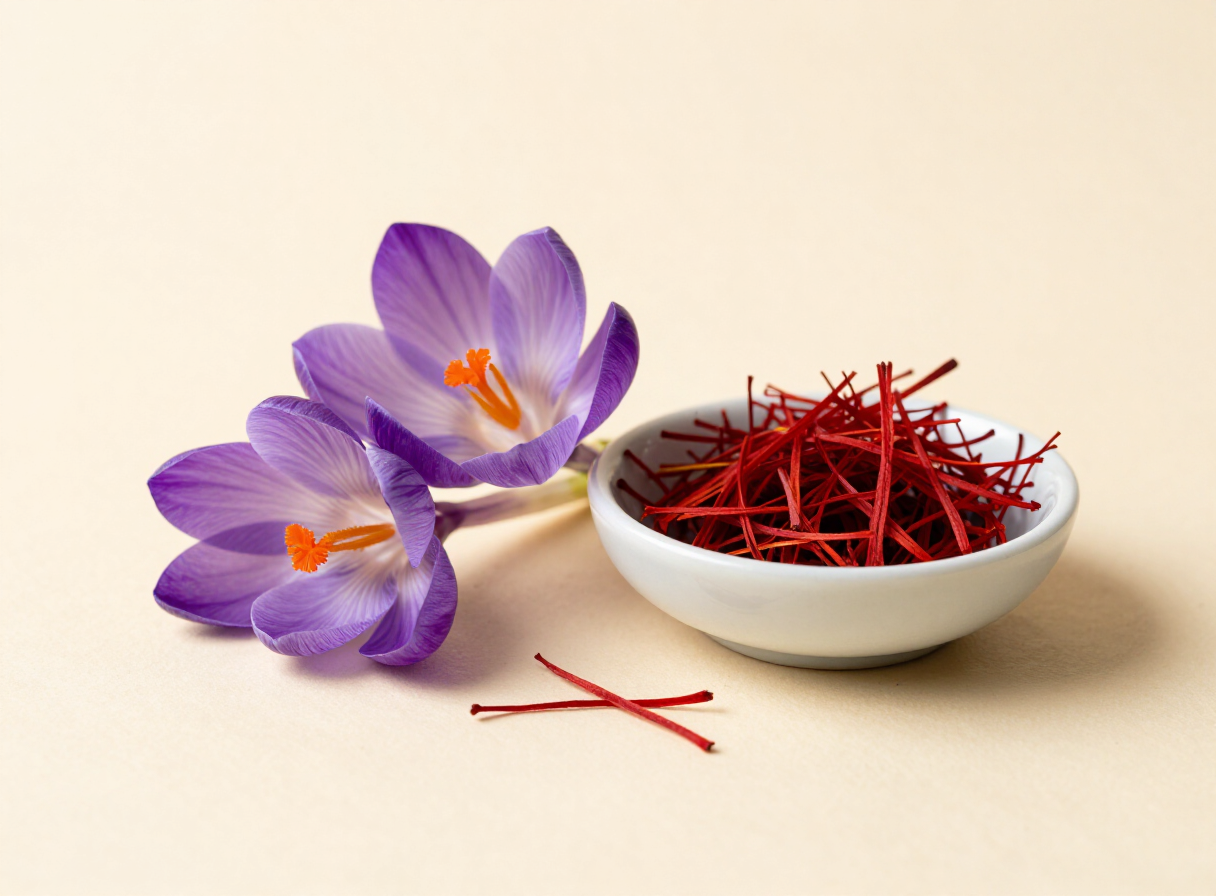
Saffron is derived from Crocus sativus L., a cultivated plant in the Iridaceae family. Human research has investigated saffron preparations for mood-related outcomes and sleep quality, but findings vary by outcome and preparation, and the evidence should not be generalized automatically across all saffron products.
Key takeaway
Saffron is not a single uniform intervention. Product identity, plant material, preparation, extract characteristics and authenticity matter. Current clinical evidence is more substantial for some mood-related outcomes than for sleep, while important uncertainty remains.
Common uses studied
Culinary spiceMood-related researchSleep-quality researchCommercial saffron extracts and supplements
Start here
What are you trying to figure out?
Pick the question closest to yours. Each card jumps to the relevant part of this profile or an existing HerbParlor tool — no sponsored rankings, no hidden ordering.
Identity
What is this herb?
Family
Iridaceae
Species
Crocus sativus L.
Common names
Saffron
Plant parts used
Dried stigmas
Geographic context
Crocus sativus is a cultivated plant with a long history of use; it is propagated and grown in several regions for its stigmas.
Identification notes
Crocus sativus L. is the canonical saffron species. Saffron should not be conflated with other Crocus species, and generic "crocus" products should not be treated as automatically equivalent to saffron. The commonly described saffron material is the dried stigmas; do not infer plant-part claims beyond the source-supported botanical description.
Background
Traditional context
Traditions
Established culinary useInvestigated in medicinal contexts
Historical uses
Culinary use as a spice and colouring agentInvestigated in medicinal and clinical research contexts
Saffron has an established culinary history and has also been investigated in medicinal contexts. Traditional or culinary use does not establish clinical efficacy, and saffron should not be described as treating depression, anxiety, insomnia or any disease on the basis of traditional or culinary use alone.
Preparations
Forms & preparations
Forms
Culinary saffron threads/stigmasSaffron stigma powderSaffron extractStandardized saffron extract where a product explicitly declares standardizationCapsulesTabletsOther liquid preparations only where a specific product supports the form
Preparation methods
Whole dried stigma usePowdered stigma preparationExtract preparationStandardized extract preparation where explicitly declared
What changes between forms
- Culinary saffron is not automatically equivalent to a standardized supplement extract.
- Stigma powder and extracts are different preparations.
- Studies of one extract should not automatically be generalized to all saffron products.
- Product labels may differ in how they describe saffron quantity and extract characteristics.
- Authenticity and compositional integrity matter when evaluating saffron.
Human studies have evaluated different saffron preparations, including stigma powder and extracts. Findings from a particular saffron preparation should not automatically be generalized to culinary saffron, stigma powder or another extract. No extract ratios, standardized percentages, crocin values, safranal values or doses are invented here.
Research
Research Explorer
Each question summarizes what human research has examined, how it was studied, and the main limitations — not a treatment recommendation.
What does current human research say about saffron and mood-related outcomes?
Population
Adults across 34 randomized controlled trials (1,769 participants).
Intervention
Crocus sativus L. supplementation (saffron monopreparations).
Comparator
Varies by included trial; commonly placebo or control.
Outcomes studied
BDI (self-reported depression)BAI (self-reported anxiety)HDRS (clinician-rated depression)HARS (clinician-rated anxiety)POMS (mood)
Evidence assessment
The 2026 systematic review and meta-analysis included 34 RCTs with 1,769 participants. It found significant reductions in self-reported BDI and BAI scores, but no significant effects on HDRS, HARS or POMS. The authors rated certainty as moderate and reported substantial heterogeneity. The evidence suggests a possible benefit for some self-reported depressive and anxiety symptoms, but the outcome pattern is not uniform and clinician-rated measures did not show significant effects in this analysis.
Limitations
- Substantial heterogeneity
- Different trials and saffron preparations
- Mixed outcome measures
- Evidence does not establish saffron as a treatment for a diagnosed psychiatric disorder
What does the human evidence say about saffron and sleep quality?
Population
Participants across five randomized clinical trials (379 participants from three countries).
Intervention
Saffron preparations.
Comparator
Varies by trial; commonly placebo or control.
Outcomes studied
Sleep qualitySleep duration
Evidence assessment
Five randomized clinical trials involving 379 participants from three countries were identified. The review provides initial evidence that saffron may influence sleep quality and duration, but the evidence base is small and should be treated cautiously.
Limitations
- Only five randomized trials
- Relatively small overall participant count
- Preparation-specific evidence
- Insufficient basis for broad treatment claims
Latest evidence
Recently published research
Looking for recent publications…
These publications are automatically discovered from Europe PMC. They have not necessarily been independently reviewed by HerbParlor and are not automatically incorporated into the evidence assessment.
Evidence
Evidence
Human research on saffron includes randomized trials and systematic reviews, particularly for mood-related symptoms and sleep quality. The strongest current synthesis is not uniformly positive across all outcome measures. Evidence should be interpreted according to the preparation studied and the outcome measured. Mood-related outcomes have been studied in multiple randomized trials; the 2026 meta-analysis found benefits on some self-reported scales but not several clinician-rated scales. Sleep evidence exists but comes from a much smaller trial base. Evidence from a particular saffron extract should not automatically be generalized to culinary saffron, stigma powder or another extract. Authenticity and compositional consistency are relevant when interpreting what a saffron product actually contains.
Evidence tier
Emerging
Confidence
Overall certainty is emerging. The mood-related evidence base is larger but heterogeneous and not uniform across self-reported and clinician-rated measures; the sleep evidence base is small. Individual study or synthesis findings should be kept distinct from the overall evidence tier and should not be generalized across saffron products.
Last evidence review
2026-09-17
Where the evidence is strongest
Some self-reported mood-related symptom measures (BDI, BAI) in a 2026 meta-analysis of 34 RCTs
How to interpret this
Current evidence does not establish saffron as a proven treatment for depression, anxiety disorders, insomnia or any other specific disease. The evidence is better described as emerging, preparation-dependent and outcome-specific, with a possible signal on some self-reported mood measures that was not mirrored across clinician-rated scales, and a small sleep evidence base. No "proven" status is assigned to any disease indication.
Automatic evidence update
Since the last editorial review
Checking for publications published since the last editorial evidence review…
This automatic update detects newly published literature; it does not replace HerbParlor's editorial evidence assessment. Review status is an automatic triage signal. Curated HerbParlor evidence is unchanged until editorial review.
Boundaries
What the evidence does NOT establish
Areas with limited evidence
- Saffron has not been established as a treatment for depression.
- Saffron has not been established as a treatment for anxiety disorders.
- Evidence from one standardized saffron extract does not automatically apply to every saffron product.
- The available sleep literature is limited and does not establish saffron as a treatment for insomnia.
- Improved scores on some self-reported measures do not establish benefit across every clinical outcome.
- More saffron or a higher declared amount does not automatically mean greater clinical effect.
- Culinary saffron and concentrated extracts should not be treated as interchangeable interventions.
- A product label alone does not establish authenticity or clinical effectiveness.
Evidence gaps
- Consistent preparation- and outcome-specific evidence across saffron products
- Larger and longer randomized trials
- Clinician-rated outcomes alongside self-reported measures
- Direct comparisons between culinary saffron, stigma powder and standardized extracts
- How closely commercial saffron products reproduce studied interventions
Common misconceptions
- All saffron products are the same preparation.
- Culinary saffron and concentrated saffron extracts are interchangeable.
- Evidence from one saffron extract automatically applies to every saffron product.
- A higher saffron amount automatically means a stronger or better product.
- A standardized extract is automatically superior to every non-standardized saffron preparation.
- Label claims about saffron quality are equivalent to independent authentication.
- Early clinical findings establish saffron as a treatment for a medical disorder.
Safety
Safety & interactions
General considerations
- Human safety evidence exists across clinical trials of saffron monopreparations, including stigma powder and extracts.
- The current systematic review of adverse events identified 102 clinical trials and one case report. Adverse-event findings should be interpreted in the context of the specific preparation and study.
Pregnancy & nursing
- Safety information during pregnancy is not established in the cited sources.
- Safety information during breastfeeding is not established in the cited sources.
- Pregnant or breastfeeding people should discuss use with a qualified healthcare professional.
Medication interactions to be aware of
No clinically important medication interactions are established in the cited sources. Do not infer the absence of a documented interaction means there is no interaction risk; people taking prescription medicines should discuss saffron use with a healthcare professional.
Condition considerations
- People considering saffron for a diagnosed mood, anxiety or sleep disorder should not self-treat in place of professional evaluation and care.
Duration
- Available safety evidence should be interpreted according to the specific preparation and study duration; long-term safety conclusions are not established in the cited sources.
Talk to a healthcare professional if any apply
- Uncertainty about the product identity or preparation
- Use of a concentrated saffron extract when safety information is unclear
- Significant adverse effects
- Questions involving medicines where interaction information is not established by the cited evidence
Products
What changes between products?
Form differences
- Culinary saffron is not automatically equivalent to a standardized supplement extract.
- Stigma powder and extracts are different preparations.
- Studies of one extract should not automatically be generalized to all saffron products.
- Product labels may differ in how they describe saffron quantity and extract characteristics.
- Authenticity and compositional integrity matter when evaluating saffron.
Form considerations
- Threads/stigmas, powder, capsules, tablets and extracts are different preparation descriptions and should not be compared only by headline saffron weight.
- Culinary saffron is not automatically equivalent to a standardized supplement extract.
Plant part considerations
- Confirm that the product identifies genuine saffron material derived from Crocus sativus where the product source supports it.
- Do not treat generic "crocus" products as automatically equivalent to saffron.
Extract considerations
- Record extract characteristics only when explicitly stated by a product source.
- Do not infer an extraction ratio or marker concentration when the label does not provide one.
Standardization considerations
- Record declared standardization only.
- Do not create a preferred crocin, safranal or other marker percentage.
- Do not imply that a higher marker concentration is automatically better.
Evaluation
How to evaluate a supplement
What to check
- Crocus sativus species identity
- Plant material/stigma identity where disclosed
- Culinary saffron versus supplement preparation
- Powder versus extract
- Standardized extract declaration where explicitly provided
- Amount and serving information
- Other ingredients
- Identity testing where disclosed
- Contaminant testing where disclosed
- Batch/lot traceability where disclosed
- Authenticity/quality controls
Serving considerations
- Compare the labelled serving and preparation with the intervention used in the research without inventing a dosage recommendation.
- A larger saffron amount does not automatically mean a stronger or better-supported product.
Testing considerations
- Look for identity/authentication testing where disclosed.
- Look for contaminant testing where disclosed.
- Look for batch or lot traceability where disclosed.
Label transparency
- The species should be identifiable where possible.
- The plant material/preparation should be clear.
- Serving information should be explicit.
- Major additional ingredients should be disclosed.
- Standardized extract claims should be specifically identified.
- Marketing language should not be treated as clinical evidence.
Supplements
Related supplements
Sources
Authoritative sources referenced
- Crocus sativus L.
Royal Botanic Gardens, Kew — Plants of the World Online · accessed 2026-09-17
- Effect of saffron on depression, anxiety and mood disorder: a GRADE assessed systematic review and meta-analysis of 34 randomized controlled trials
PubMed / Clinical Nutrition · 2026-07 · accessed 2026-09-17
- Saffron and Sleep Quality: A Systematic Review of Randomized Controlled Trials
PubMed · 2023 · accessed 2026-09-17
- Adverse Events of Saffron (Crocus sativus L.): Systematic Review of Current Evidence
PubMed / Health Science Reports · 2026-04-27 · accessed 2026-09-17
- Combating saffron fraud: a systematic review of adulteration practices, detection technologies, recommendations and challenges
PubMed / Critical Reviews in Food Science and Nutrition · 2026 · accessed 2026-09-17
Sections reviewed
overviewbotanicaltraditionalContextpreparationsresearchevidencesafetyproductEvaluationrelationshipssources
Created the Saffron Herb Profile v1 with botanical identity, preparation-aware evidence synthesis for mood and sleep, cautious safety framing, authenticity/adulteration considerations, product-evaluation criteria and auditable source/review metadata.
This profile is provided for educational purposes only and is not medical advice. Traditional context and research summaries are distinguished from claims, and nothing here is a treatment recommendation. Always consult a qualified healthcare professional before using any herb, especially if you are pregnant, nursing, take medication, or have a medical condition.