
 Moderate evidence
Milk Thistle
Silybum marianum (L.) Gaertn.
Overview
At a glance
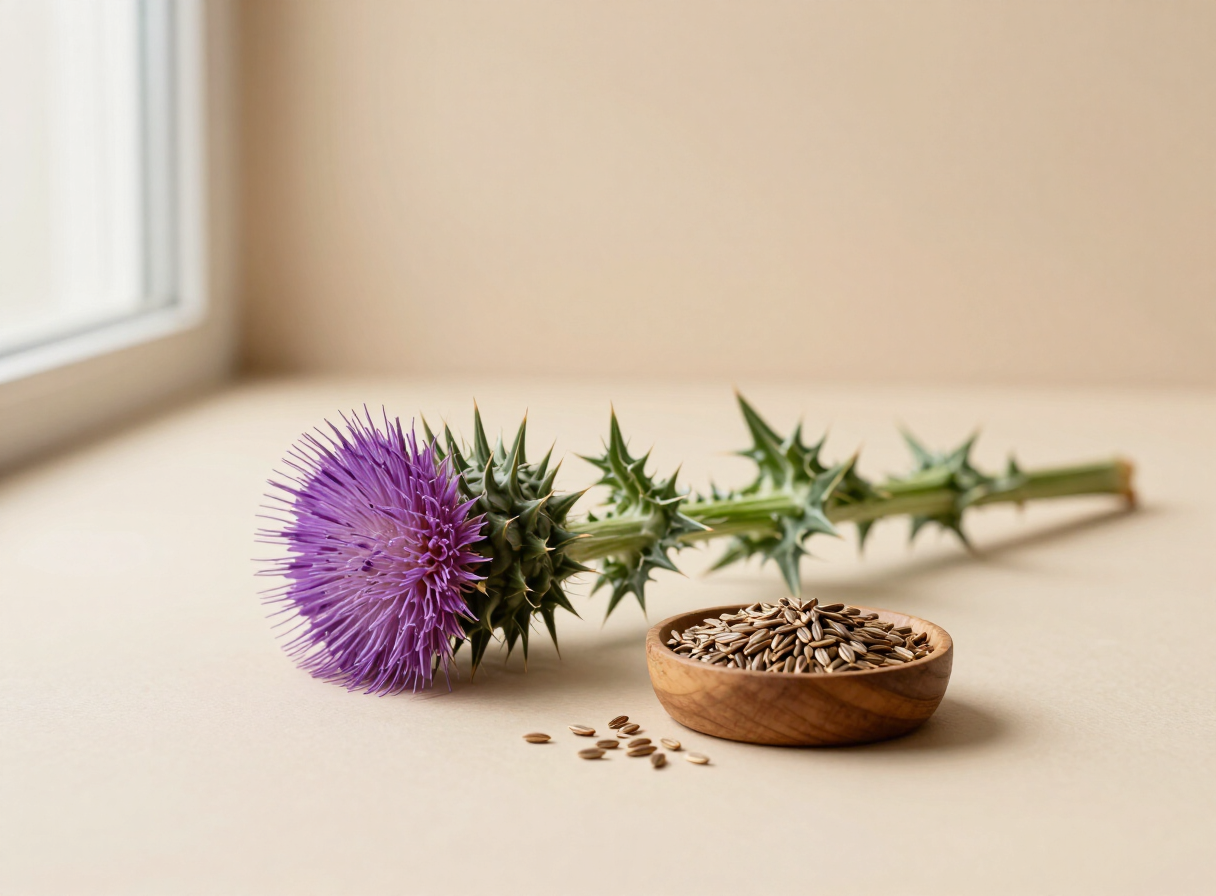
Milk thistle is the fruit of Silybum marianum, with human research focused particularly on liver-related and metabolic questions. Evidence varies by outcome and preparation.
Key takeaway
Milk thistle is not one standardized intervention: whole fruit, extracts and standardized silymarin preparations can differ substantially, so evidence should be matched to the actual preparation studied.
Common uses studied
Liver-related researchMetabolic health researchTraditional digestive and liver-related usesCommercially marketed liver-support products
Start here
What are you trying to figure out?
Pick the question closest to yours. Each card jumps to the relevant part of this profile or an existing HerbParlor tool — no sponsored rankings, no hidden ordering.
Identity
What is this herb?
Family
Asteraceae
Species
Silybum marianum (L.) Gaertn.
Common names
Milk thistleMarietidselHoly thistle
Plant parts used
FruitSeed
Geographic context
Silybum marianum is native to the Mediterranean region and is now widely distributed and cultivated in many parts of the world.
Identification notes
Milk thistle is Silybum marianum. The medicinal material commonly described in regulatory sources is the fruit, while commercial products may refer to seeds or seed-derived extracts. Silymarin is a mixture of flavonolignans derived from milk-thistle fruit rather than the botanical itself.
Background
Traditional context
Traditions
European traditional herbal medicineMediterranean traditional use
Historical uses
Digestive complaintsLiver-related traditional useGallbladder-related traditional use
Traditional use provides historical context but does not establish that milk thistle treats liver disease or other modern clinical conditions.
Preparations
Forms & preparations
Forms
Whole fruit or seedPowdered fruitFruit extractStandardized silymarin extractPhospholipid/phytosome-style preparationsCapsules and tabletsCombination liver-support products
Preparation methods
Whole-material powderExtract preparationStandardized extract preparationPhospholipid-complex formulations
What changes between forms
- Whole milk-thistle fruit is not equivalent to a concentrated silymarin extract.
- Silymarin is a mixture of flavonolignans rather than the botanical itself.
- Extracts can differ in concentration, extraction process and constituent profile.
- Phospholipid or other delivery systems can materially change product formulation and should not automatically be assumed equivalent to conventional extracts.
Human studies have evaluated different milk-thistle and silymarin preparations. Evidence from a particular standardized preparation should not automatically be generalized to every milk-thistle supplement.
Research
Research Explorer
Each question summarizes what human research has examined, how it was studied, and the main limitations — not a treatment recommendation.
Can milk thistle or silymarin improve liver-related biomarkers?
Population
Adults studied in randomized clinical trials involving liver-related conditions or elevated liver enzymes.
Intervention
Milk thistle or standardized silymarin preparations.
Comparator
Placebo or control.
Outcomes studied
ALTASTOther liver-related laboratory markers
Evidence assessment
Promising biochemical signals have been reported, but results are heterogeneous and biomarker improvement does not by itself establish clinical benefit.
Limitations
- Different preparations
- Different populations
- Different doses and durations
- Biochemical outcomes may not translate into clinical benefit
Sources
- Milk Thistle: Usefulness and Safety
- Effects of silymarin supplementation on liver and kidney functions: A systematic review and dose-response meta-analysis
- Effects of silymarin use on liver enzymes and metabolic factors in metabolic dysfunction-associated steatotic liver disease: a systematic review and meta-analysis
Does milk thistle improve outcomes in fatty liver disease?
Population
Adults studied in NAFLD/MASLD and related metabolic liver conditions.
Intervention
Milk thistle or silymarin preparations.
Comparator
Placebo or control.
Outcomes studied
Liver enzymesMetabolic markersDisease-related measures
Evidence assessment
Preliminary and mixed. Some meta-analyses report improvements in biochemical markers, but clinical efficacy is not established.
Limitations
- Small evidence base
- Preparation variability
- Biomarker-focused outcomes
- Limited high-quality long-term evidence
Sources
- Milk Thistle: Usefulness and Safety
- Effects of silymarin use on liver enzymes and metabolic factors in metabolic dysfunction-associated steatotic liver disease: a systematic review and meta-analysis
- Silymarin in non-cirrhotics with non-alcoholic steatohepatitis: A randomized, double-blind, placebo controlled trial
Does standardized silymarin improve non-alcoholic steatohepatitis outcomes?
Population
Adults with non-cirrhotic non-alcoholic steatohepatitis.
Intervention
A proprietary standardized silymarin preparation.
Comparator
Placebo.
Outcomes studied
Liver histologyLiver enzymesClinical and metabolic measures
Evidence assessment
A randomized controlled trial did not establish a significant primary histological benefit.
Limitations
- Specific proprietary preparation
- Specific study population
- Single major randomized trial
- Results should not be generalized to all milk-thistle products
Does silymarin improve chronic hepatitis C outcomes?
Population
Adults with chronic hepatitis C who had not responded to interferon therapy.
Intervention
High-dose silymarin preparations.
Comparator
Placebo.
Outcomes studied
ALTLiver-related laboratory outcomesClinical measures
Evidence assessment
A randomized controlled trial did not demonstrate a significant improvement in the primary ALT outcome.
Limitations
- Specific disease population
- Specific high-dose preparation
- Primary outcome was biochemical
- Findings should not be generalized to all liver conditions
Does milk thistle treat established liver disease?
Population
Adults with chronic liver conditions studied in clinical trials.
Intervention
Milk thistle or silymarin preparations.
Comparator
Placebo or control.
Outcomes studied
Disease progressionLiver-related clinical outcomesLaboratory measures
Evidence assessment
Insufficient for a broad claim that milk thistle treats established liver disease.
Limitations
- Conflicting clinical evidence
- Different liver diseases
- Different preparations
- Limited long-term outcome data
How established are other marketed milk-thistle health claims?
Population
People using milk thistle for conditions beyond the better-studied liver-related questions.
Intervention
Various milk-thistle preparations.
Comparator
Varies.
Outcomes studied
Condition-specific outcomes
Evidence assessment
Insufficient for broad clinical conclusions.
Limitations
- Limited clinical evidence
- Different products and preparations
- Traditional and marketing claims exceed the established evidence base
Latest evidence
Recently published research
Looking for recent publications…
These publications are automatically discovered from Europe PMC. They have not necessarily been independently reviewed by HerbParlor and are not automatically incorporated into the evidence assessment.
Evidence
Evidence
Milk thistle has a substantial human research literature and some promising biochemical signals, but evidence does not establish it as a proven treatment for liver disease. Results vary by outcome, population and preparation.
Evidence tier
Moderate
Confidence
Moderate for the existence of human research signals around liver-related biomarkers; lower for claims of clinical disease treatment or for applying evidence from one silymarin preparation to all milk-thistle products.
Last evidence review
2026-09-15
Where the evidence is strongest
Liver-related biomarker researchFatty-liver biochemical outcomes
How to interpret this
The evidence is best understood as preparation- and outcome-specific. Some studies report improvements in laboratory markers, but those findings should not be converted into a blanket claim that milk thistle treats or detoxifies the liver.
Automatic evidence update
Since the last editorial review
Checking for publications published since the last editorial evidence review…
This automatic update detects newly published literature; it does not replace HerbParlor's editorial evidence assessment. Review status is an automatic triage signal. Curated HerbParlor evidence is unchanged until editorial review.
Boundaries
What the evidence does NOT establish
Areas with limited evidence
- Treatment of established liver disease
- NASH clinical outcomes
- Chronic hepatitis C treatment
- Broad liver-detox claims
- Other marketed health uses
Evidence gaps
- Clinically meaningful long-term outcomes
- Optimal preparation
- Optimal silymarin standardization
- Direct comparison of whole fruit versus standardized extract
- Head-to-head product comparisons
- How closely commercial products match clinical trial interventions
Common misconceptions
- Milk thistle and silymarin are the same thing.
- All milk-thistle supplements are equivalent.
- A higher milligram amount automatically means more silymarin.
- More silymarin automatically means a better product.
- Milk thistle is proven to detoxify the liver.
- Improving ALT or AST automatically means a liver disease has been treated.
- Evidence from one standardized silymarin extract applies automatically to every milk-thistle product.
- Milk thistle is proven to treat fatty liver disease.
- Milk-thistle products are automatically safe simply because they are marketed for liver support.
- Traditional liver use establishes modern clinical efficacy.
Safety
Safety & interactions
General considerations
- Oral milk thistle appears generally well tolerated in studied adults, but evidence on long-term medicinal use remains limited.
- Common adverse effects include gastrointestinal symptoms such as bloating, nausea and gas.
- Supplement composition and quality can vary, including differences between stated and measured silymarin content.
- People with known allergy or hypersensitivity to milk thistle or related Asteraceae plants should use particular caution.
Contraindications
- Known hypersensitivity or allergy to milk thistle.
- Known hypersensitivity to related Asteraceae (Compositae) plants.
Pregnancy & nursing
- Safety during pregnancy has not been adequately established.
- Safety during breastfeeding has not been adequately established.
- Pregnant or breastfeeding people should discuss use with a qualified healthcare professional.
Medication interactions to be aware of
Available evidence does not establish a major clinically important interaction profile, but theoretical pharmacokinetic interactions have been investigated.People taking prescription medicines should not assume that a lack of a documented interaction means there is no interaction risk.People taking multiple medicines should discuss milk-thistle use with a healthcare professional.
Condition considerations
- Milk thistle should not be used as a substitute for evaluation or treatment of diagnosed liver disease.
- People with liver disease should discuss supplement use with a healthcare professional, especially when using concentrated extracts.
- People with strong Asteraceae allergies may warrant additional caution.
Reported adverse effects
- Bloating
- Nausea
- Gas
- Other gastrointestinal upset
- Allergic reactions
- Rare hypersensitivity reactions
Duration
- Long-term medicinal-dose safety is not well established.
- Clinical studies have used different preparations and durations, so safety findings should not automatically be generalized to every commercial product.
Talk to a healthcare professional if any apply
- Pregnancy or breastfeeding
- Known Asteraceae allergy
- Diagnosed liver disease
- Multiple prescription medicines
- Use of concentrated or highly standardized extracts
- Persistent or worsening liver-related symptoms
Products
What changes between products?
Form differences
- Whole milk-thistle fruit is not equivalent to a concentrated silymarin extract.
- Silymarin is a mixture of flavonolignans rather than the botanical itself.
- Extracts can differ in concentration, extraction process and constituent profile.
- Phospholipid or other delivery systems can materially change product formulation and should not automatically be assumed equivalent to conventional extracts.
Form considerations
- Whole fruit or seed products are not equivalent to concentrated silymarin extracts.
- Capsules, powders, extracts and phospholipid-complex products should be treated as different preparations unless the evidence specifically supports equivalence.
Plant part considerations
- Check whether the product identifies fruit, seed or seed-derived extract material.
- Do not assume that all plant-material descriptions represent the same medicinal preparation.
Extract considerations
- Identify whether the product uses whole material, a conventional extract, a standardized extract or a phospholipid-complex preparation.
- Where available, record extraction ratio and declared extract characteristics.
Standardization considerations
- Check whether silymarin content is declared.
- A stated silymarin percentage helps describe the product but does not by itself establish clinical superiority.
- Different standardizations should not automatically be treated as clinically interchangeable.
Evaluation
How to evaluate a supplement
What to check
- Silybum marianum identity
- Fruit or seed material
- Whole material versus extract
- Declared silymarin content
- Standardization information
- Extract ratio or preparation details where supplied
- Additional ingredients
- Identity and contaminant testing
- Batch or lot traceability
Serving considerations
- Compare the actual serving and preparation with the intervention used in the research.
- Do not compare products solely by total milligrams of milk-thistle material.
Testing considerations
- Look for identity testing.
- Look for contaminant testing.
- Batch or lot traceability can provide additional product-quality information.
Label transparency
- The label should clearly identify Silybum marianum and the relevant plant material.
- The preparation or extract type should be identifiable where possible.
- Declared silymarin content should be distinguishable from total extract or plant-material weight.
- Combination liver-support products should clearly disclose their other active ingredients.
- Marketing terms such as liver detox or liver cleanse should not be treated as evidence of clinical efficacy.
Categories
Related categories
Explore the HerbParlor categories this herb is grouped under.
Supplements
Related supplements
Sources
Authoritative sources referenced
- Milk Thistle: Usefulness and Safety
National Center for Complementary and Integrative Health · 2025-02 · accessed 2026-09-15
- Silybi mariani fructus - herbal medicinal product
European Medicines Agency · 2018-09-19 · accessed 2026-09-15
- Milk Thistle
NCBI LiverTox · 2020-01-21 · accessed 2026-09-15
- Effects of silymarin supplementation on liver and kidney functions: A systematic review and dose-response meta-analysis
PubMed · 2024-05 · accessed 2026-09-15
- Effects of silymarin use on liver enzymes and metabolic factors in metabolic dysfunction-associated steatotic liver disease: a systematic review and meta-analysis
PubMed · 2024-02-26 · accessed 2026-09-15
- Silymarin in non-cirrhotics with non-alcoholic steatohepatitis: A randomized, double-blind, placebo controlled trial
PubMed · 2019-09-19 · accessed 2026-09-15
- Effect of silymarin (milk thistle) on liver disease in patients with chronic hepatitis C unsuccessfully treated with interferon therapy: a randomized controlled trial
PubMed · 2012-07-18 · accessed 2026-09-15
Sections reviewed
overviewbotanicaltraditionalContextpreparationsresearchevidencesafetyproductEvaluationrelationshipssources
Completed the Milk Thistle Herb Profile v1 with preparation-aware safety guidance, product-evaluation criteria and auditable review metadata grounded in authoritative and clinical sources.
This profile is provided for educational purposes only and is not medical advice. Traditional context and research summaries are distinguished from claims, and nothing here is a treatment recommendation. Always consult a qualified healthcare professional before using any herb, especially if you are pregnant, nursing, take medication, or have a medical condition.