
 Emerging evidence
Elderberry
Sambucus nigra L.
Overview
At a glance
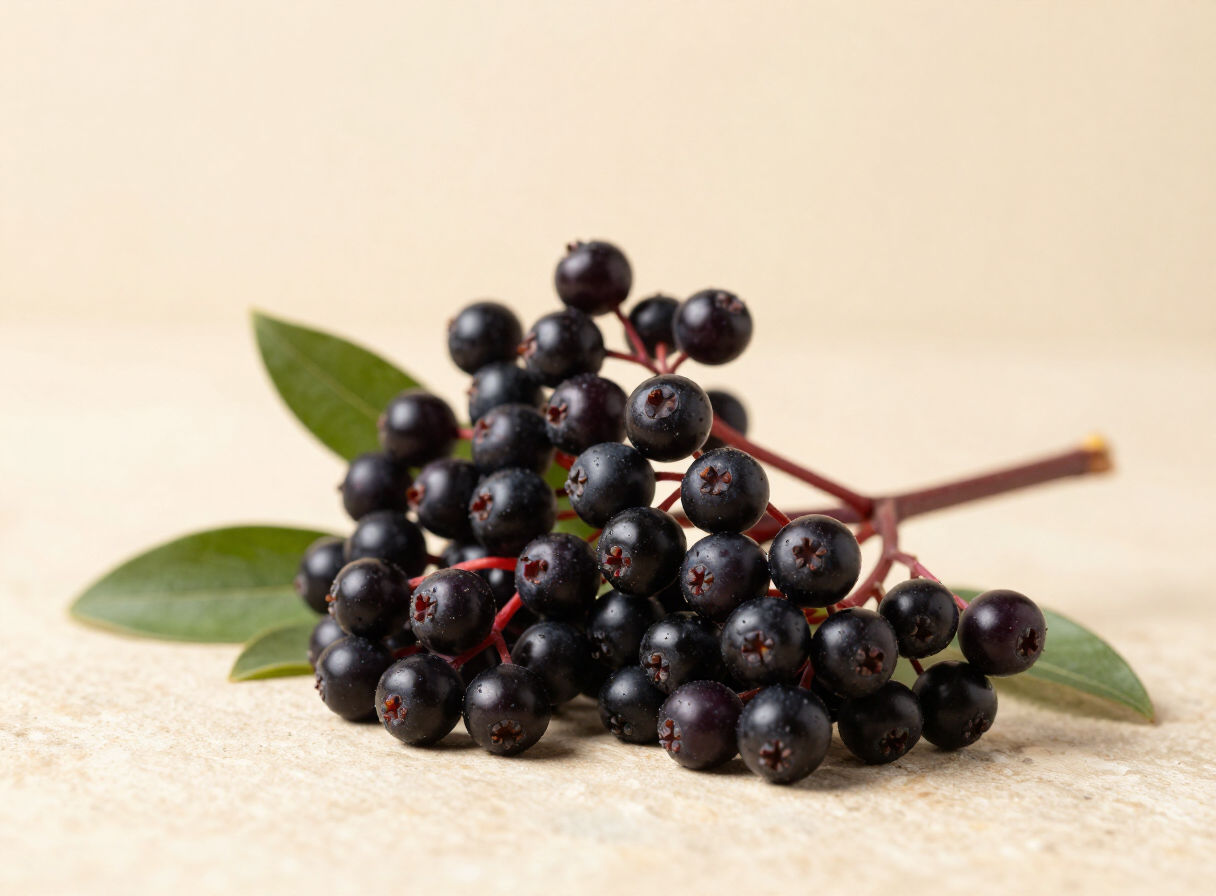
Elderberry is the fruit of Sambucus nigra, a European elder species in the Adoxaceae family. Human research around colds, influenza and upper respiratory infections is limited and heterogeneous.
Key takeaway
Elderberry is not one standardized intervention: species, plant material (fruit versus flower), preparation and whether the fruit has been properly cooked can materially change both how the evidence should be interpreted and whether a product is safe.
Common uses studied
Common cold prevention and treatment researchInfluenza-related researchUpper respiratory infection researchTraditional food and preserve uses of cooked ripe fruit
Start here
What are you trying to figure out?
Pick the question closest to yours. Each card jumps to the relevant part of this profile or an existing HerbParlor tool — no sponsored rankings, no hidden ordering.
Identity
What is this herb?
Family
Adoxaceae
Species
Sambucus nigra L.
Common names
ElderberryEuropean elderBlack elderCommon elder
Plant parts used
Ripe fruit (berry)Flower (elderflower)
Geographic context
Sambucus nigra is native to Europe and parts of Asia and North Africa and is widely naturalized elsewhere.
Identification notes
Only common elder, Sambucus nigra, should be used. Elderberry and elderflower are different plant materials and should not be treated as interchangeable. Other Sambucus species and other elder plant parts are not equivalent and may present different safety considerations.
Background
Traditional context
Traditions
European traditional food and folk use
Historical uses
Cooked ripe fruit as food and preservesTraditional cold and respiratory-season useElderflower as a distinct traditional plant material
Traditional food and folk use provides historical context but does not by itself establish modern clinical efficacy for colds, influenza or any other condition.
Preparations
Forms & preparations
Forms
Cooked ripe fruitFruit extractFruit juice and syrupLozengesCapsules and tabletsStandardized fruit extractCombination productsElderflower (a distinct plant material)
Preparation methods
Cooking or boiling ripe fruitExtractionStandardized extract preparation
What changes between forms
- Raw or unripe elderberries and other elder plant parts can contain poisonous cyanide-producing substances and should not be consumed raw.
- Elderberries should be boiled for 15–20 minutes before consumption to address naturally occurring toxic substances.
- Elderberry fruit and elderflower are different plant materials and should be distinguished on the label.
- A standardized fruit extract studied in a particular trial should not automatically be assumed equivalent to every elderberry product.
Clinical studies have evaluated different elderberry preparations, including a standardized extract in an air-travel trial. Findings from one preparation should not be generalized to all elderberry products or preparations.
Research
Research Explorer
Each question summarizes what human research has examined, how it was studied, and the main limitations — not a treatment recommendation.
What does the overall human evidence show?
Population
People studied in human elderberry research for colds, influenza and upper respiratory infections.
Intervention
Different elderberry preparations and extracts.
Comparator
Varies by study; commonly placebo or control.
Outcomes studied
Cold occurrenceCold duration and severityInfluenza duration and severityUpper respiratory infection outcomes
Evidence assessment
NCCIH states that human research for colds, influenza and upper respiratory infections is limited, that some preliminary research suggests possible symptom benefit, and that evidence is insufficient for firm conclusions.
Limitations
- Limited evidence base
- Heterogeneous preparations and outcomes
- Small or short-term studies
- Insufficient evidence for firm conclusions
Can elderberry prevent or shorten colds?
Population
Participants across five randomized trials included in a systematic review.
Intervention
Elderberry preparations.
Comparator
Placebo or control.
Outcomes studied
Risk of developing a common coldCold durationCold severity
Evidence assessment
The systematic review found that evidence elderberry reduces the risk of developing a common cold was not established. Elderberry may reduce duration or severity of colds, but certainty was low or uncertain.
Limitations
- Only five randomized trials
- Low or uncertain certainty
- Preparation heterogeneity
- Risk of bias assessed across heterogeneous studies
Does elderberry reduce influenza duration or severity?
Population
87 emergency-room patients aged 5 and above with PCR-confirmed influenza.
Intervention
Elderberry extract.
Comparator
Placebo.
Outcomes studied
Influenza durationInfluenza severity
Evidence assessment
The randomized, double-blind, placebo-controlled trial found no evidence that elderberry reduced influenza duration or severity. The study was relatively small and explicitly described its findings as conflicting with previous studies.
Limitations
- Relatively small sample
- Specific preparation and population
- Findings conflict with previous studies
- A single trial does not determine the overall evidence tier
What did the air-travel cold trial find?
Population
312 economy-class air travellers in a randomized, double-blind, placebo-controlled clinical trial.
Intervention
A standardized elderberry extract.
Comparator
Placebo.
Outcomes studied
Respiratory and cold outcomes
Evidence assessment
The trial studied a standardized elderberry extract and respiratory and cold outcomes. This is preparation-specific evidence and its findings should not be generalized to all elderberry products or preparations.
Limitations
- Specific standardized extract
- Specific air-travel population
- No automatic equivalence across products
- Preparation-specific rather than class-level evidence
Is there evidence supporting elderberry for COVID-19?
Population
People considering elderberry for COVID-19.
Intervention
Elderberry preparations.
Comparator
Not established.
Outcomes studied
COVID-19-related outcomes
Evidence assessment
NCCIH states that there is no good evidence supporting elderberry for COVID-19.
Limitations
- No good evidence for COVID-19
- Findings from cold and influenza research should not be transferred to COVID-19
- COVID-19 is a distinct illness
What does composition and quality research tell us?
Population
European elderberry and other Sambucus nigra subspecies analyzed in a comprehensive review.
Intervention
Plant-material composition analysis.
Comparator
Not applicable.
Outcomes studied
Phenolic compoundsNutrientsCyanogenic glycosides
Evidence assessment
The review describes variation in phenolic compounds, nutrients and cyanogenic glycosides across European elderberry and other Sambucus nigra subspecies. This is product-quality and plant-material context and should not be converted into clinical efficacy.
Limitations
- Composition is not efficacy
- Subspecies variation
- No clinical outcomes assessed
- Relevant to product-quality differentiation rather than treatment claims
Latest evidence
Recently published research
Looking for recent publications…
These publications are automatically discovered from Europe PMC. They have not necessarily been independently reviewed by HerbParlor and are not automatically incorporated into the evidence assessment.
Evidence
Evidence
Overall human evidence for elderberry is limited and heterogeneous. NCCIH states that human research for colds, influenza and upper respiratory infections is limited and that evidence is insufficient for firm conclusions, and that there is no good evidence supporting elderberry for COVID-19. A 2021 systematic review of five randomized trials found that evidence elderberry reduces the risk of developing a common cold was not established, and that elderberry may reduce cold duration or severity only with low or uncertain certainty. A 2020 randomized, double-blind, placebo-controlled trial in 87 PCR-confirmed influenza patients found no evidence that elderberry reduced influenza duration or severity and described its findings as conflicting with previous studies. A 2016 air-travel trial studied a standardized elderberry extract specifically, demonstrating why its findings should not be generalized to all elderberry products. A 2024 composition review describes variation in phenolic compounds, nutrients and cyanogenic glycosides across Sambucus nigra subspecies and is relevant to product quality rather than clinical efficacy.
Evidence tier
Emerging
Confidence
Overall certainty remains limited because the studies differ in preparation, population, outcome and methods. Individual study findings should be kept distinct from the overall evidence tier and should not be generalized across elderberry products.
Last evidence review
2026-09-16
Where the evidence is strongest
Possible reduction in cold duration or severity with low or uncertain certainty
How to interpret this
Current evidence does not establish elderberry as a proven treatment for colds, influenza, COVID-19 or any other specific condition. The evidence is better described as limited, heterogeneous and preparation-dependent, with a possible low-certainty signal for cold duration or severity and a negative influenza trial. Raw elderberry safety is a separate and important consideration regardless of efficacy.
Automatic evidence update
Since the last editorial review
Checking for publications published since the last editorial evidence review…
This automatic update detects newly published literature; it does not replace HerbParlor's editorial evidence assessment. Review status is an automatic triage signal. Curated HerbParlor evidence is unchanged until editorial review.
Boundaries
What the evidence does NOT establish
Areas with limited evidence
- Prevention of the common cold
- Treatment of influenza
- COVID-19
- Broad immune-support claims
- Health uses outside the better-studied respiratory questions
Evidence gaps
- Larger and longer randomized trials
- Consistent preparation and outcome definitions
- Preparation-specific rather than class-level evidence
- How closely commercial products reproduce studied interventions
- Composition-to-efficacy translation
Common misconceptions
- All elderberry supplements are equivalent.
- Elderberry fruit and elderflower are interchangeable.
- Raw elderberries are safe to consume.
- Elderberry has been proven to prevent colds.
- Elderberry has been proven to treat influenza.
- There is good evidence supporting elderberry for COVID-19.
- Evidence from a standardized extract automatically applies to every elderberry product.
- Immune-support marketing claims establish clinical effectiveness.
- Chemical composition (phenolics, nutrients) establishes clinical efficacy.
- Traditional food use establishes modern clinical efficacy.
Safety
Safety & interactions
General considerations
- Raw or unripe elderberries and other elder plant parts can contain poisonous cyanide-producing substances.
- Raw elderberries can cause vomiting, diarrhea and abdominal pain.
- Both mature and immature raw elderberries can contain naturally occurring toxic substances.
- Elderberries should be boiled for 15–20 minutes before consumption.
- Only common elder, Sambucus nigra, should be used.
- Elderflower and elderberry are different plant materials and should be distinguished.
- Pregnancy and breastfeeding safety information for elderberry is limited.
Contraindications
- Raw or unripe elderberries and other raw elder plant parts
- Elder species other than Sambucus nigra
Pregnancy & nursing
- Safety information during pregnancy is limited.
- Safety information during breastfeeding is limited.
- Pregnant or breastfeeding people should discuss use with a qualified healthcare professional.
Medication interactions to be aware of
No clinically important medication interactions are established in the cited sources. Do not infer the absence of a documented interaction means there is no interaction risk; people taking prescription medicines should discuss elderberry use with a healthcare professional.
Condition considerations
- People considering elderberry for COVID-19 should be aware that there is no good evidence supporting such use.
- People with symptoms of a respiratory illness that persist or worsen should seek medical advice rather than self-treating with elderberry.
Reported adverse effects
- Vomiting (from raw elderberry)
- Diarrhea (from raw elderberry)
- Abdominal pain (from raw elderberry)
Duration
- Safety information for longer-term supplement use is limited; the cited sources primarily address short-term use and food-safety preparation.
Talk to a healthcare professional if any apply
- Pregnancy or breastfeeding
- Symptoms that persist or worsen despite use for a respiratory illness
- Consideration of elderberry for COVID-19
- Use of prescription medicines
- Any reaction after consuming raw or unripe elderberry
- Uncertainty about whether a product is Sambucus nigra or has been properly prepared
Products
What changes between products?
Form differences
- Raw or unripe elderberries and other elder plant parts can contain poisonous cyanide-producing substances and should not be consumed raw.
- Elderberries should be boiled for 15–20 minutes before consumption to address naturally occurring toxic substances.
- Elderberry fruit and elderflower are different plant materials and should be distinguished on the label.
- A standardized fruit extract studied in a particular trial should not automatically be assumed equivalent to every elderberry product.
Form considerations
- Cooked ripe fruit, fruit extracts and standardized extracts are different preparation descriptions and should not be compared only by headline milligram amount.
- A product should be compared with the actual preparation used in the relevant research rather than treated as automatically equivalent.
Plant part considerations
- Check whether the label identifies elderberry fruit or elderflower, because they are different plant materials.
- Confirm the material is Sambucus nigra rather than another elder species.
Extract considerations
- Identify whether the product is described as whole fruit, a fruit extract or a standardized extract.
- Do not infer an extraction ratio or marker concentration when the label does not provide it.
Standardization considerations
- Record any stated standardization, but do not treat it as proof of clinical equivalence or superiority.
- Standardization information helps distinguish products but does not by itself establish efficacy.
Evaluation
How to evaluate a supplement
What to check
- Sambucus nigra species identity
- Elderberry fruit versus elderflower
- Whether the fruit has been properly cooked or prepared
- Whole fruit versus extract versus standardized extract
- Preparation matching the relevant research
- Additional ingredients and combination products
- Identity and contaminant testing where available
- Batch or lot traceability where available
Serving considerations
- Compare the labelled serving and preparation with the intervention used in the research without inventing a dosage recommendation.
- A larger milligram number does not necessarily mean a stronger or better-supported product.
Testing considerations
- Look for identity and contaminant testing where available.
- Look for batch or lot traceability where available.
Label transparency
- The label should identify Sambucus nigra and distinguish elderberry fruit from elderflower.
- The preparation or extract type should be identifiable where possible.
- Combination products should clearly disclose their other active ingredients.
- Immune-support marketing language should not be treated as evidence that the product reproduces a clinically studied intervention.
Categories
Related categories
Explore the HerbParlor categories this herb is grouped under.
Supplements
Related supplements
- Elderberry, 500 Mg, 60 Veg CapsNow FoodsView product
- Elderberry, 450 mg, 100 CapsSolarayView product
- Elderberry Standardized Extract, 400 mg, 60 CapsQuantum HealthView product
- Sambucus Black Elderberry Alcohol-Free, 12,000 Mg, 16 OzNature's AnswerView product
- Wellness Elderberry Liquid Extract, 2 ozSource NaturalsView product
- Black Elderberry Glycerite, 1 OzHerb PharmView product
- Full Spectrum Elderberry Extract, 525 mg, 90 TabsPlanetary HerbalsView product
- Organics Elderberry Syrup, 6.59 OzGarden of LifeView product
- Nordbo Elderberry KidsNordboView product
Sources
Authoritative sources referenced
- Elderberry: Usefulness and Safety
National Center for Complementary and Integrative Health · accessed 2026-09-16
- Hyldebær
Danish Veterinary and Food Administration · accessed 2026-09-16
- Sambuci fructus
European Medicines Agency · 2014-04-29 · accessed 2026-09-16
- Elderberry for prevention and treatment of viral respiratory illnesses: a systematic review
BMC Complementary Medicine and Therapies / PubMed · 2021-04-07 · accessed 2026-09-16
- Elderberry Extract Outpatient Influenza Treatment for Emergency Room Patients Ages 5 and Above: A Randomized, Double-Blind, Placebo-Controlled Trial
PubMed · 2020-10-01 · accessed 2026-09-16
- Elderberry supplementation reduces cold duration and symptoms in air-travellers: a randomized, double-blind placebo-controlled clinical trial
PubMed · 2016-03-22 · accessed 2026-09-16
- Elderberry, an Ancient Remedy: A Comprehensive Study of the Bioactive Compounds in Three Sambucus nigra L. Subspecies
Annual Review of Food Science and Technology / PubMed · 2024-06-20 · accessed 2026-09-16
Sections reviewed
overviewbotanicaltraditionalContextpreparationsresearchevidencesafetyproductEvaluationrelationshipssources
Created the canonical Elderberry Herb Profile v1 with species- and plant-material-aware identity, an explicit raw-berry safety layer, preparation distinctions, evidence boundaries and source-linked research context.
Regulatory sources are included for context only. Regulatory status is not evidence for or against efficacy, and is not a treatment or safety recommendation.
This profile is provided for educational purposes only and is not medical advice. Traditional context and research summaries are distinguished from claims, and nothing here is a treatment recommendation. Always consult a qualified healthcare professional before using any herb, especially if you are pregnant, nursing, take medication, or have a medical condition.